Ekanem & Adeilé
Civil Wedding — Mood Board for Ardus Media
the Abe's · 31 · 07 · 26
The Approach
Mood
Quiet luxury, editorial, unhurried. Think Riviera / Lake Como dolce vita — not a highlight reel. Romance carried by stillness, silhouettes and texture rather than fast cuts or trending-audio energy.
Format Mix
Three textures, one film: (1) clean cinematic digital for portraits and wides, (2) retro texture — Super-8, camcorder/VHS, film grain and light leaks — for the ceremony and attitude beats, (3) drone for establishers. Cut between them deliberately.
Camera & Pacing
Locked-off symmetry, one-point perspective, top-down aerials, long-lens candids. Hold shots longer than feels comfortable. Flash zooms and crash-ins are accents only — one or two per sequence.
Sound
Record everything live: vows, signatures, laughter, water, cutlery. The camcorder ceremony segment should live on real audio. Score is warm and vintage — strings/Italian classics energy, no trending sounds.
Opening & Place
Establish the villa, the water, the gardens — the film starts with where, not who.
Drone title card
8s · aerial · narratedWhy: top-down aerial of villa, gardens and water with a spoken/text welcome — this is the opening of our film.
- Top-down rise-and-rotate over the venue before guests arrive
- Overlay serif title: “here to celebrate the marriage of Ekanem & Adeilé”
- Slow, stately speed — no whip moves
Ceremony setup, empty
5s · elevated wideWhy: the dressed, empty ceremony garden by the water — anticipation before anyone sits down.
- Shoot the full setup finished and empty (chairs, candles, staircase aisle)
- Elevated angle or drone at low altitude, slow lateral drift
- Pairs with the lookbook “Details” section
Avenue walk — one-point perspective
4s · locked wideWhy: symmetrical hedge corridor, couple small in frame walking to camera. Architecture frames the people.
- Find the most symmetrical axis of the venue; centre it perfectly
- Couple starts far, walks in — no camera movement (or a barely-there push)
- Let them be tiny in frame at first; scale is the point
Lakeside stillness
5s · locked wideWhy: couple posed apart on a deck against water and mountains — fashion-campaign stillness.
- Tripod, dead-centre horizon, generous negative space
- Direct the couple to hold poses — micro-movement only (wind, a head turn)
- Use as a breathing space between energetic sequences
Bride & Editorial Attitude
Solo portraits and styled group moments — lookbook sections “Solo shot” and “Bridal gang”.
Bridal silhouette in the garden
8s · portrait · duskWhy: backlit veil silhouette framed by foliage — the single most cinematic bridal beat on this board.
- Golden hour / dusk; expose for the sky so the bride falls to silhouette
- Shoot profile, veil catching light; bouquet in hand
- Foreground leaves framing the lens for depth; slow drift or stillness
Super-8 attitude poses
1.5s · film · punch-inWhy: film borders, sunglasses, a crash zoom — pure attitude in under two seconds.
- Super-8 or faithful emulation (borders, gate weave, grain)
- Couple holds a pose; abrupt zoom punch-in as the accent
- Use these as rhythm hits in the edit — never more than 2s each
Bridal party tableau
16s · landscape · slow pushWhy: the whole party staged like a fashion campaign — layered front to back, couple leading, cigar-and-sunglasses cool.
- Stage the full party on the lawn in layers; couple front and centre
- Everyone still, faces relaxed — attitude, not grins
- One slow push-in; let micro-movements (smoke, wind, a glance) carry it
- Mirror the lookbook “Bridal gang” styling
The Ceremony — Documentary Heart
The emotional core. Shot like memory, not like content.
Camcorder civil ceremony
29s · VHS/camcorder · with soundWhy: the reference for the whole ceremony treatment — retro camcorder look, ring exchange, dress details, family embraces, cheering exit on the steps. Nostalgia that will age beautifully.
- Dedicate one shooter to a camcorder (or emulation w/ timestamp overlay) for the entire ceremony
- Cover: rings, signatures, hands, the kiss, hugs with parents, the exit
- Real audio throughout — vows and reactions are the soundtrack here
- Handheld, imperfect framing welcome — it should feel found
Guest candids — arrivals & pews
58s · long lens · observationalWhy: unposed documentary of guests arriving, a flower girl wandering, laughter in the seats — the “real people” texture between editorial beats.
- Long lens, distance, never direct the guests
- Hunt reactions: laughter, tears, kids being kids
- Matches lookbook “Candid moments / with the girls & boys”
On the Water — theAbe's
The boat is the signature of this wedding. Lookbook pennant flying.
Film-grain boat, light leaks
5s · film textureWhy: a wooden Riva-style boat on the lake drowned in flares and grain — romance as texture.
- Film emulation: heavy grain, light leaks, blown highlights are the look
- Shoot the boat from shore or chase boat, sun into lens
- Colour: warm, slightly faded — no clean digital sharpness
Wake shot — the exit
3s · portrait · from bowWhy: couple lounging at the stern in white, wake churning, coastline receding — the “off into forever” beat.
- Shoot from the bow looking back over the couple at the wake
- Keep horizon level and high in frame; couple relaxed, not posing at camera
- Use late in the film as the departure/next-chapter moment
Night — The Finale
Candlelight to sparks to fireworks. End big, end intimate.
Cake cutting, cold sparks
6s · static wide · nightWhy: cold-spark fountains flanking the cake table, couple centred — celebration staged like theatre.
- Static wide, couple dead-centre between the fountains
- Expose for the sparks; let the couple go semi-silhouette
- Cut to this on the first burst — sync with a musical hit
Fireworks kiss — closing frame
5s · portrait · slow-moWhy: the kiss on the terrace over the water, fireworks column behind, a boat drifting past — “the moment you feel forever”. This is the last shot of the film.
- Frame couple against the water with the railing as foreground line
- Fireworks launch directly behind them; slow motion on the kiss
- Hold well past the kiss — let the smoke drift before cutting to black
The Approach — Stills
Look
Film-adjacent grade, soft contrast, true skin tones. Roughly 40% of final gallery in black & white — the B&W frames carry the editorial weight. Nothing over-retouched; grain welcome.
Two Modes
(1) Editorial: directed, still, fashion-campaign posing — sunglasses, attitude, architecture. (2) Documentary: long-lens, unposed, real laughter and tears. Every section below needs both.
Light
Natural window light for getting ready; open shade and golden hour outdoors; candlelight exposed as candlelight at dinner (no fill); direct on-camera flash only as an after-party style choice.
Framing Devices
Mirrors, doorways, staircases (especially top-down spirals), veils as tents, reflections, foreground foliage. Let architecture and geometry frame people — repeated motif across the whole lookbook.
Getting Ready
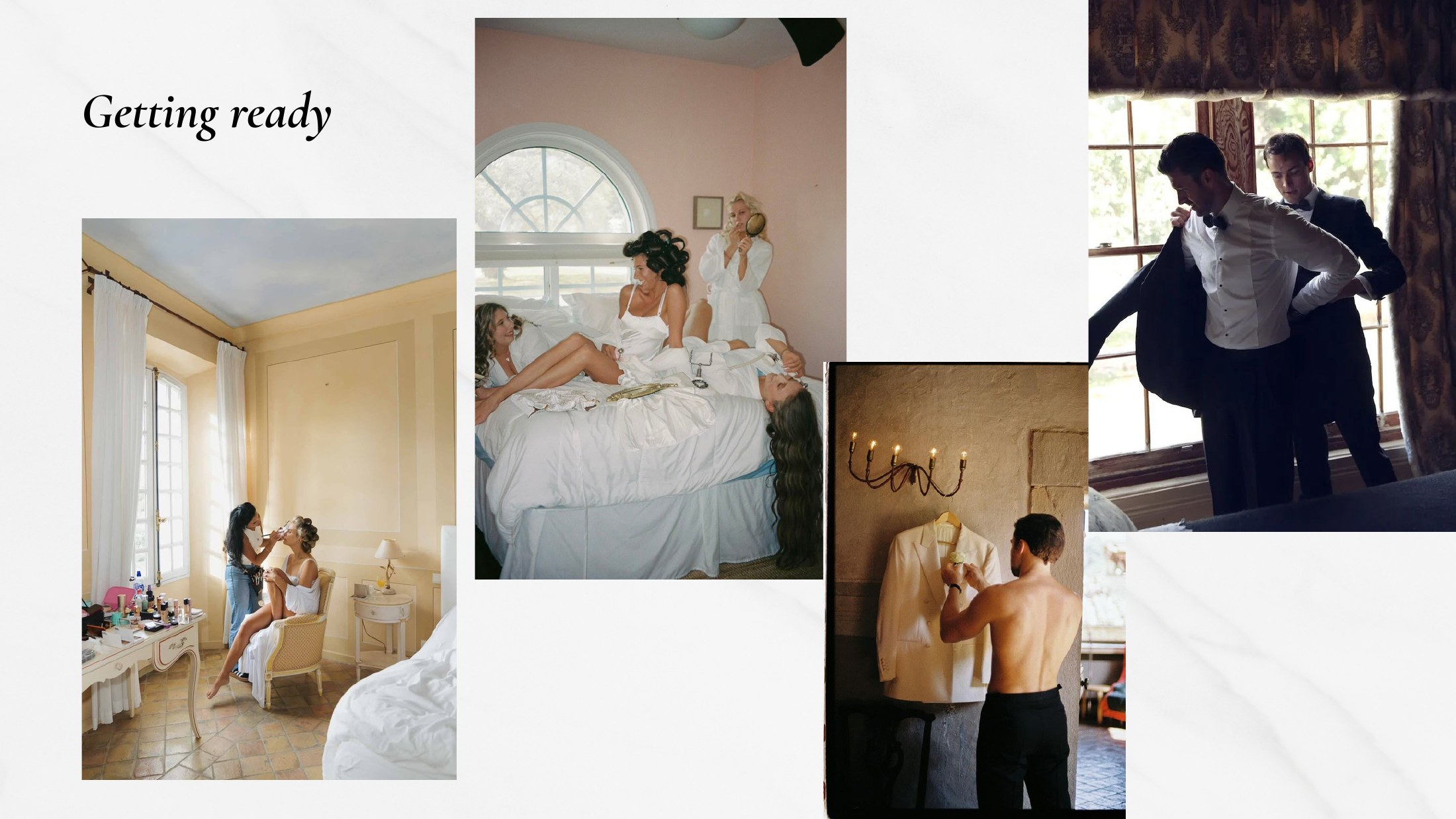
Must Capture
- Bride at the vanity, hair in rollers, champagne — shot wide to include the room
- Girls piled on the bed in slips/robes — relaxed, editorial, not posed at camera
- Groom’s jacket being helped on; suit hanging against textured wall, candlelit
- Shirtless groom steaming/prepping the white jacket — quiet, moody frame
How to Shoot
- Window light only; embrace the mess of the room — it’s part of the story
- Wide environmental frames over tight crops; let ceilings and windows breathe
- One staged tableau per room, then step back and document
Candid Moments — With the Girls / Boys
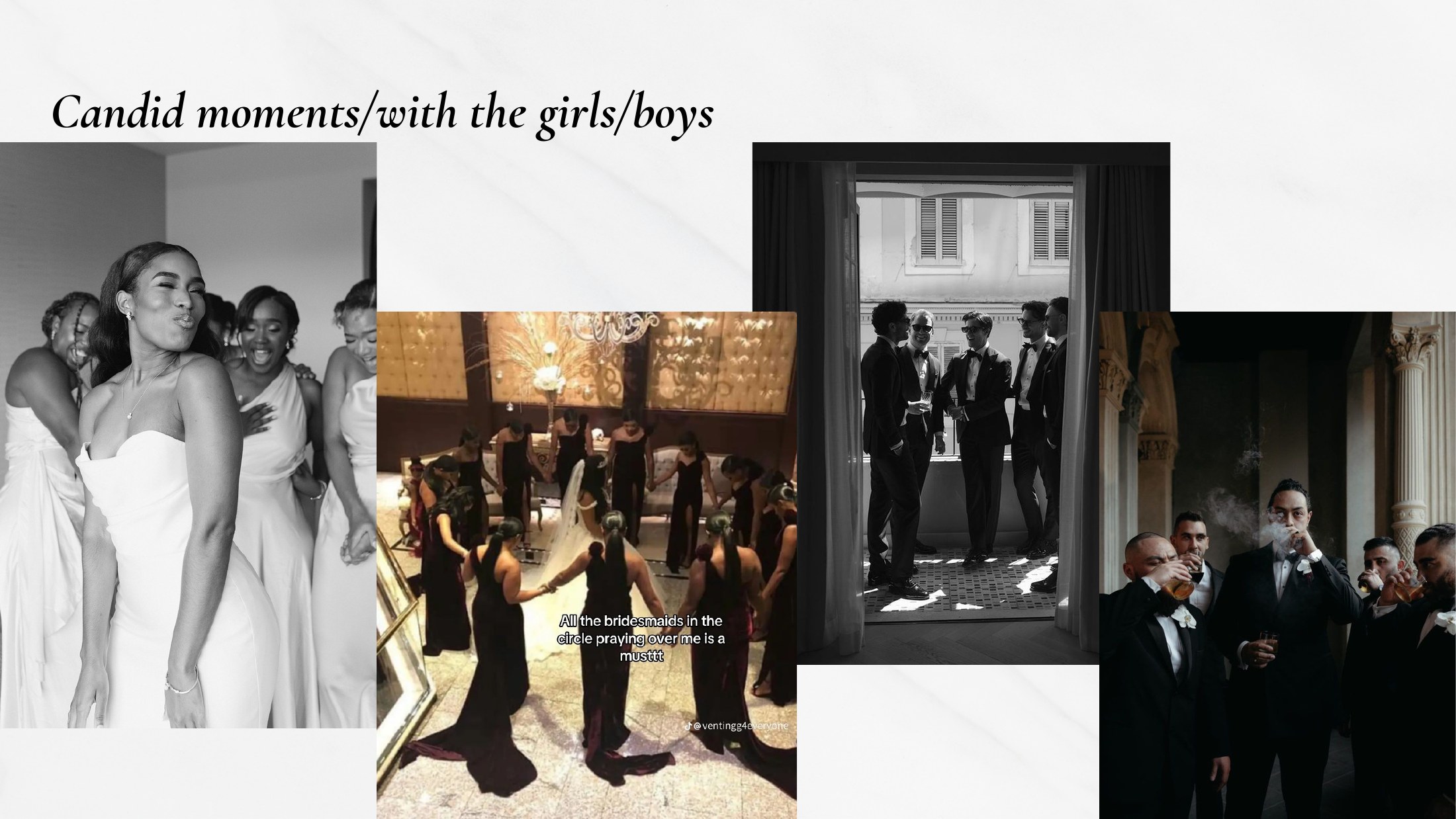
Must Capture
- B&W squeeze-hug with the girls — mid-laugh, faces crushed together
- Prayer circle over the bride (elevated angle looking down)
- Groomsmen on the balcony in silhouette/backlight, mid-conversation
- Whisky-and-cigar frame with the boys — dark, clubby, low-key light
How to Shoot
- Long lens, no direction — these fail the second they feel staged
- Push B&W treatment on the emotional frames
- Backlit doorways and windows for the groups; expose for highlights
Solo Shots — Bride / Groom
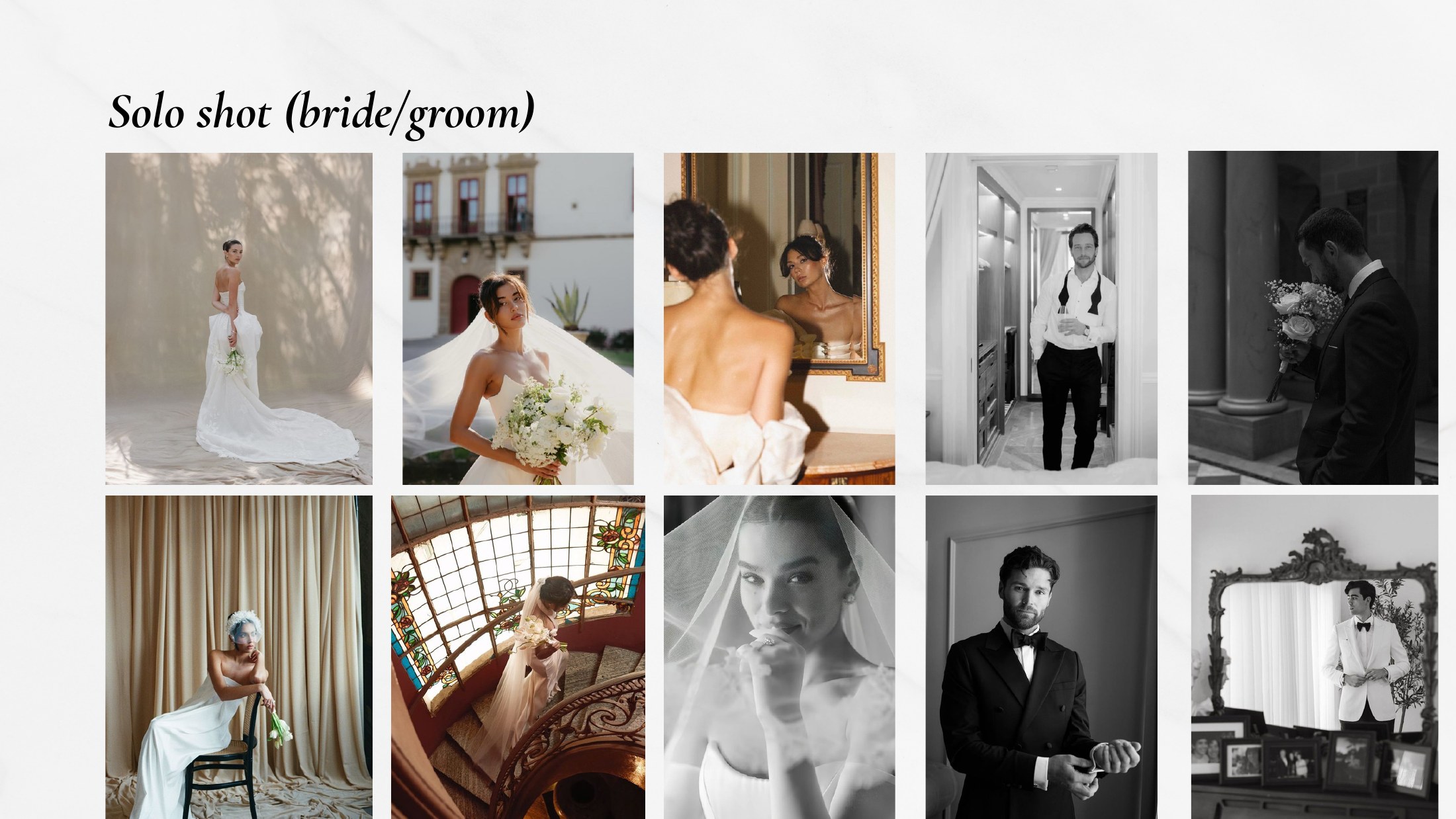
Must Capture
- Bride full-length against dappled light / textured backdrop, train pooled
- Mirror portrait — bride’s reflection with bare back in frame
- Veil-over-face close-up, hand at chin, ring visible
- Groom in low-key B&W adjusting cuffs; groom in hallway/closet doorway
- Groom head bowed over the boutonnière/bouquet — quiet emotion
How to Shoot
- One clean styled setup each (backdrop or curtain), rest found locations
- Underexpose the groom’s frames — shadow is the mood
- Mix colour and B&W deliberately; stairwells and stained glass if available
First Look — Reaction
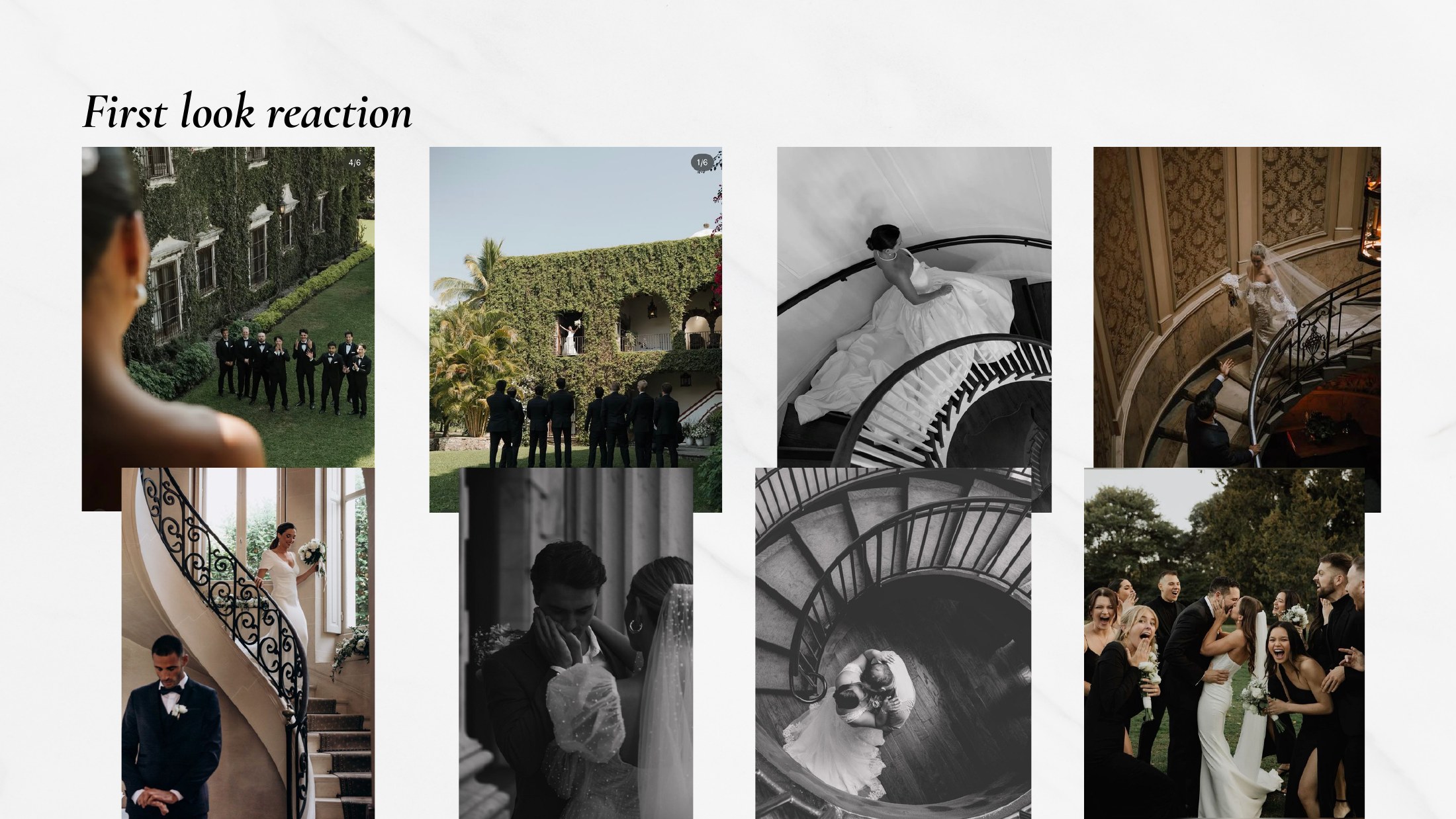
Must Capture
- Over-the-bride’s-shoulder from a balcony/window down to the waiting party
- Top-down spiral staircase — bride descending, dress filling the frame
- Groom waiting at the bottom of the stairs, not yet turned
- The party’s scream — wide frame, every face reacting
- Tears close-up: hand on his face, B&W
How to Shoot
- Scout the staircase in advance — the top-down spiral is a signature shot
- Two shooters: one on the descending bride, one on reactions
- Do the couple first look AND a party reveal — both are on the board
First Look — Couple
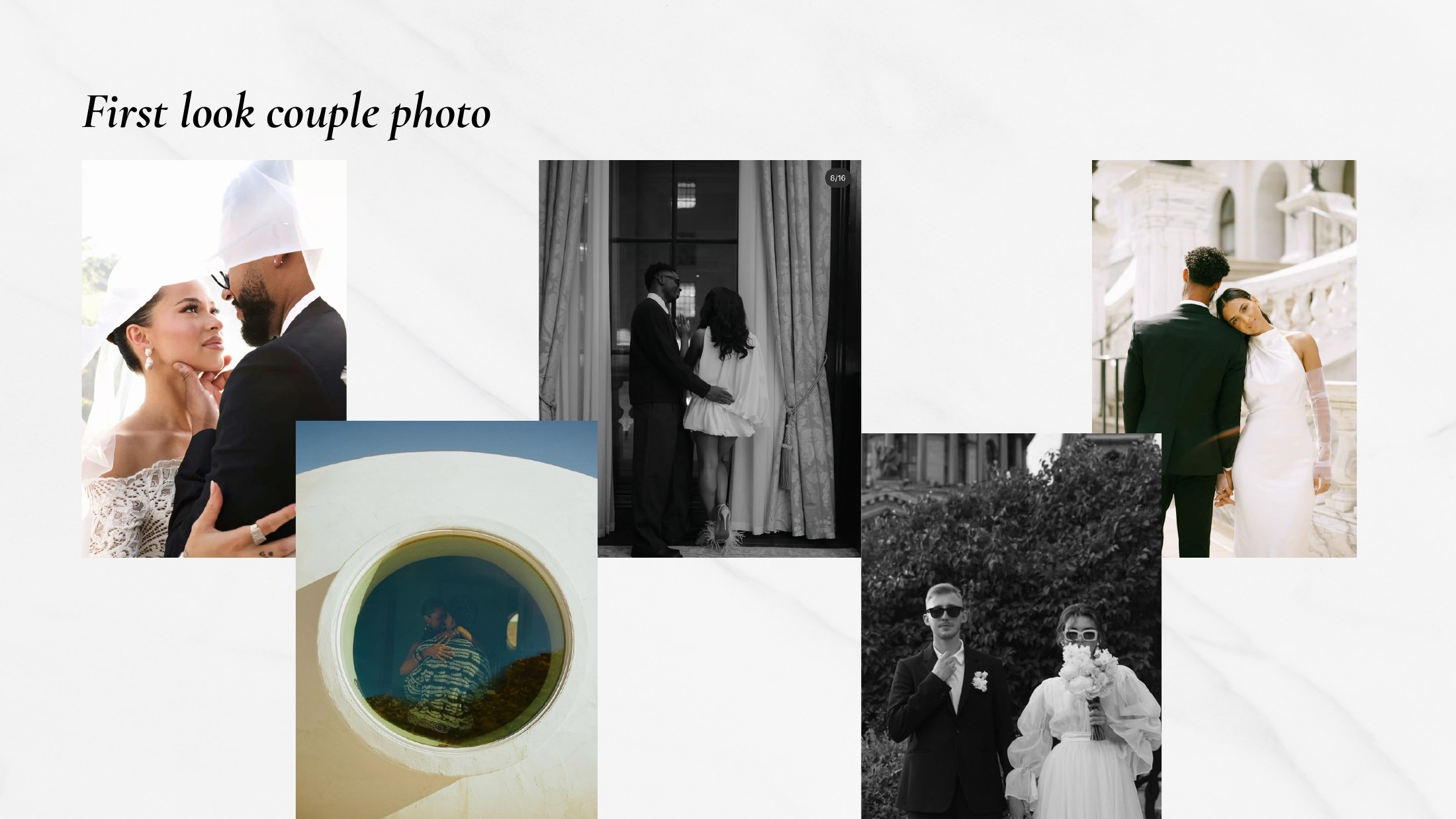
Must Capture
- Under-the-veil close-up — his hand at her chin, both inside the veil
- Couple at the window between curtains, B&W, from behind
- Her head on his shoulder, both facing away, architecture behind
- Sunglasses fashion frame — deadpan, bouquet raised over her face
- One creative reflection (porthole, mirror, water)
How to Shoot
- Intimacy first, then attitude — shoot tender before styled
- Use framing devices: curtains, veil, circular openings
- Keep several frames faceless (backs, hands, silhouettes) — very lookbook
Bridal Gang
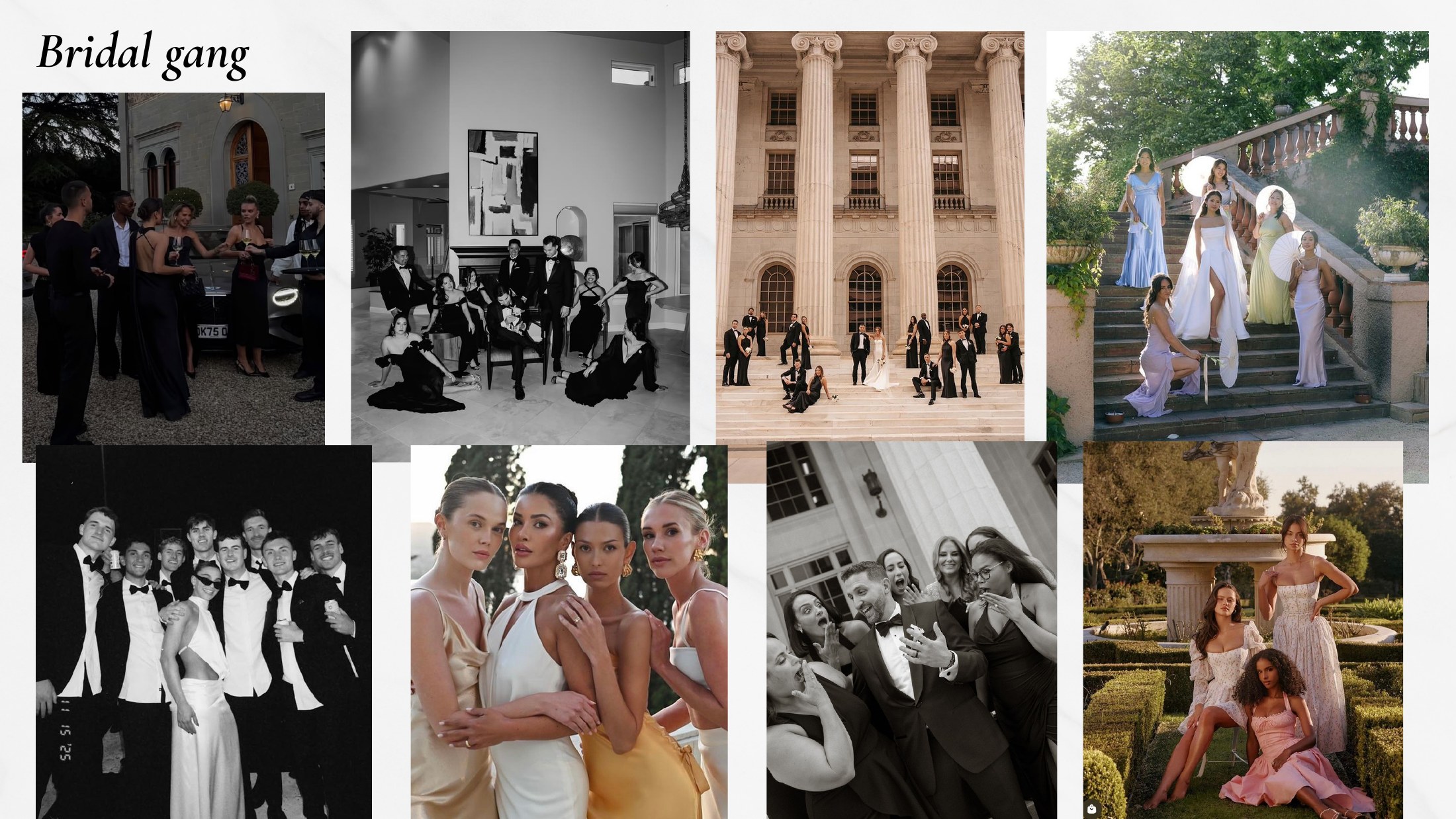
Must Capture
- Full squad on grand steps/staircase — couple centred, party staggered
- Girls in a tight beauty cluster — faces close, editorial gaze
- Boys in B&W, drinks in hand, loose and laughing
- Lounge tableau — everyone draped over furniture like a campaign
- Garden frames with statues/hedges as set dressing
How to Shoot
- Use architecture as risers — steps beat flat ground every time
- Shoot each formation twice: composed/serious, then the laugh after
- Vary distance — one wide showing the building, one tight on faces
Ceremony
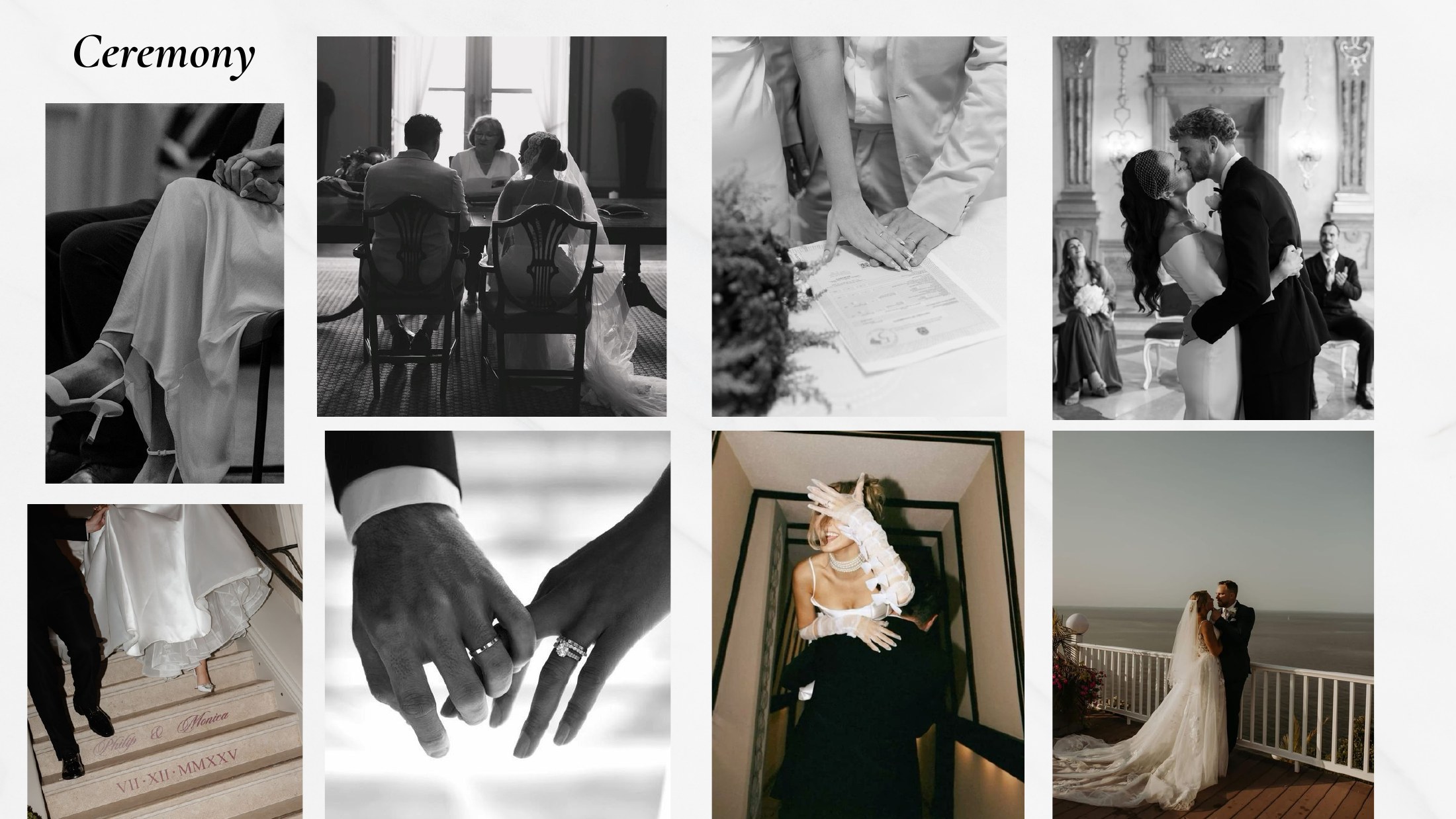
Must Capture
- Signing table from behind the couple — officiant facing, B&W
- Hands on the marriage certificate — document detail
- The kiss with witnesses seated around — grand room, wide
- Macro: both hands, both rings
- Shoe/hem detail while seated; gloved arms around his neck
- Exit down the steps; terrace embrace over the water at dusk
How to Shoot
- Civil ceremony = the signing IS the ceremony; cover the table like an altar
- Heavy B&W ratio here — this section is almost all monochrome on the board
- Quiet, no flash, no repositioning mid-ceremony — long lens from fixed points
Details
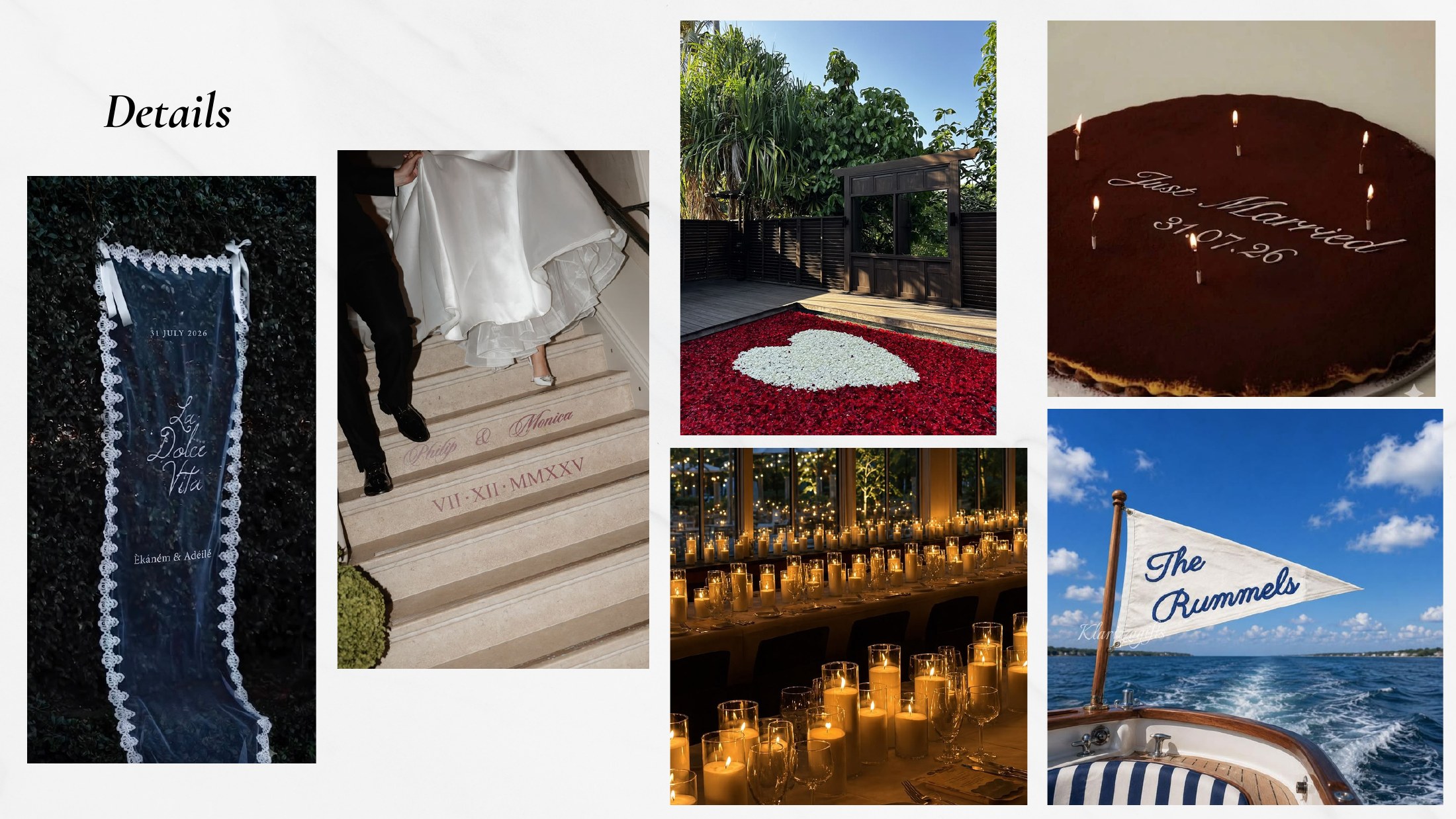
Must Capture
- The embroidered “theAbe's — Ekanem & Adeilé” veil, hung and backlit
- Personalised stair runner with names + date, feet mid-step on it
- Petal heart installation from above
- “Just Married 31.07.26” cake with lit candles
- Candlelit tablescape — sea of candles, no overheads
- Boat pennant flying against the water
How to Shoot
- Every commissioned piece twice: clean/staged AND in use
- Shoot details at dusk where candles are involved — expose for flame
- These frames anchor the album spreads; treat them as heroes, not filler
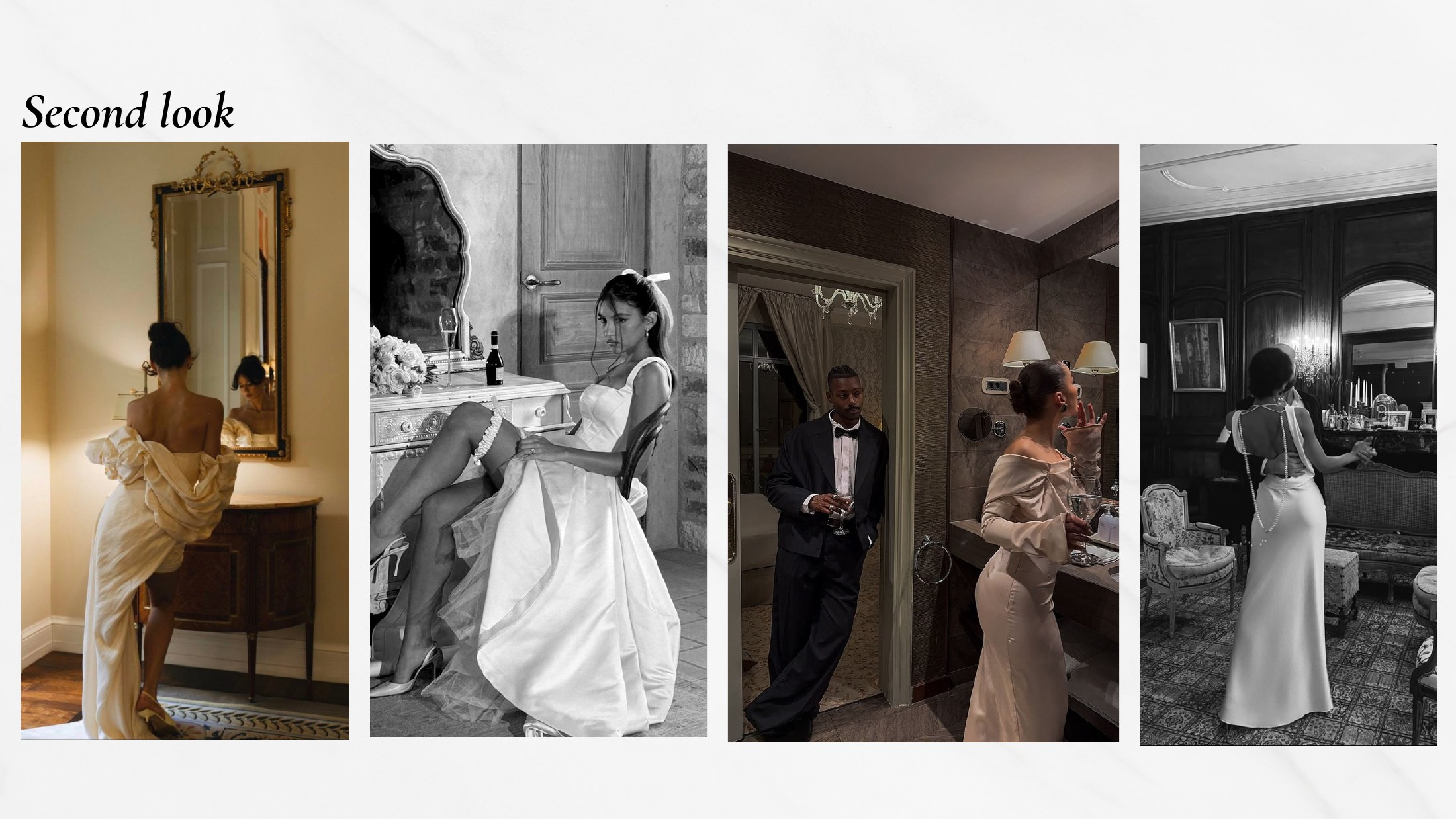
Second Look
Must Capture
- Mirror moment — dress slipping off shoulder, warm lamp light
- Garter adjustment seated at the vanity, B&W
- Him in the doorway watching her at the bathroom mirror
- Back detail: pearls/jewellery against bare back, B&W
How to Shoot
- Low tungsten light, intimate, editorial — boudoir-adjacent but elegant
- Mirrors do the work: shoot reflections, not faces
- Keep this set tight — 20 minutes, two rooms, no entourage
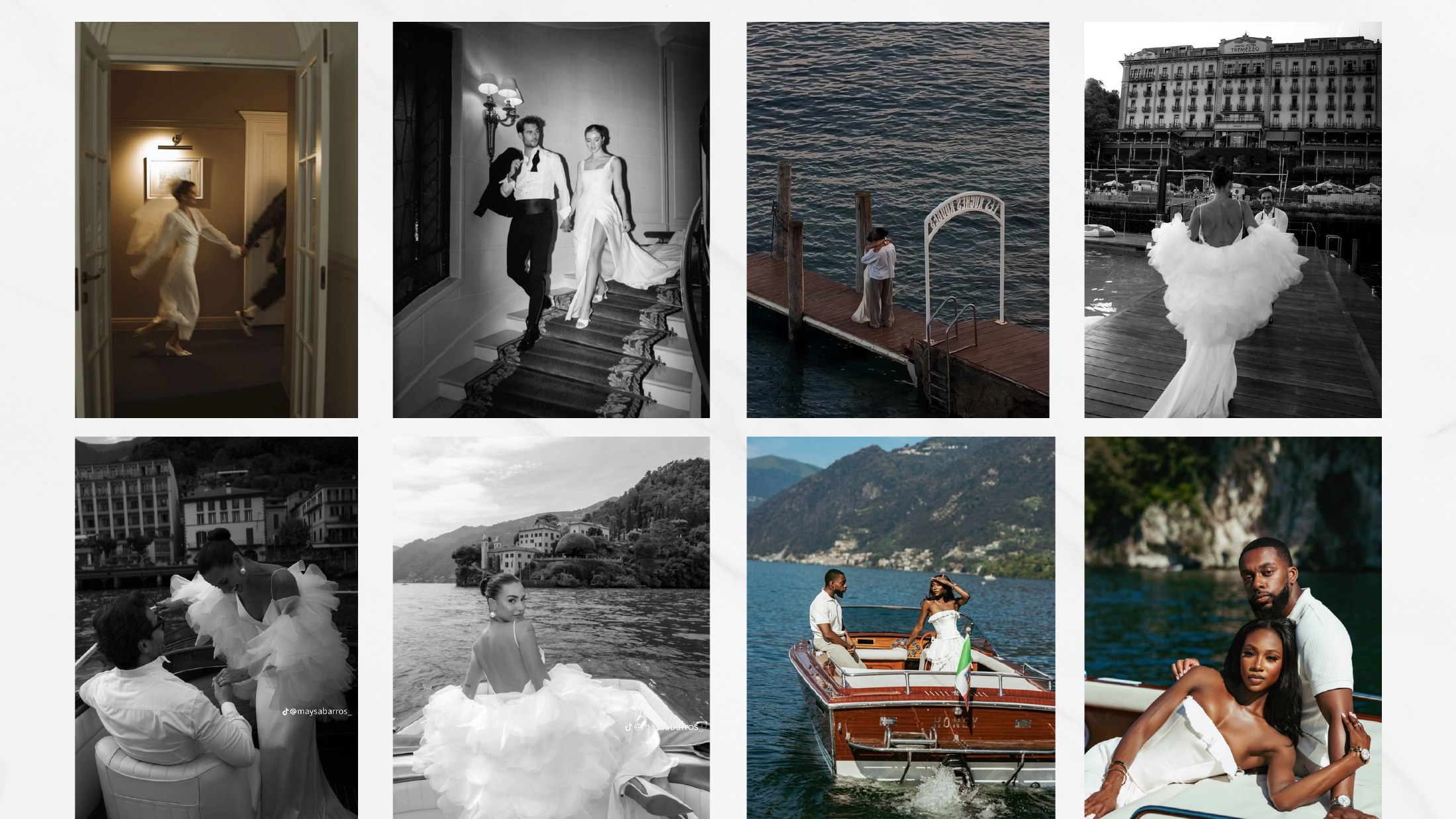
Golden Hour — On the Water
Must Capture
- Corridor run — motion blur, her dress flying, him pulling her along
- Stair descent hand-in-hand, B&W, patterned runner
- Dock embrace at the water’s edge; tulle dress spilling on the dock
- Boat departure — her waving/standing, grand hotel behind
- Lounging portraits on the boat — his arms around her, direct gaze
How to Shoot
- Reserve 45 min at golden hour for the dock + boat set — non-negotiable
- Slow shutter for the corridor run; everything else crisp
- Shoot from a chase boat or dock for departure wides
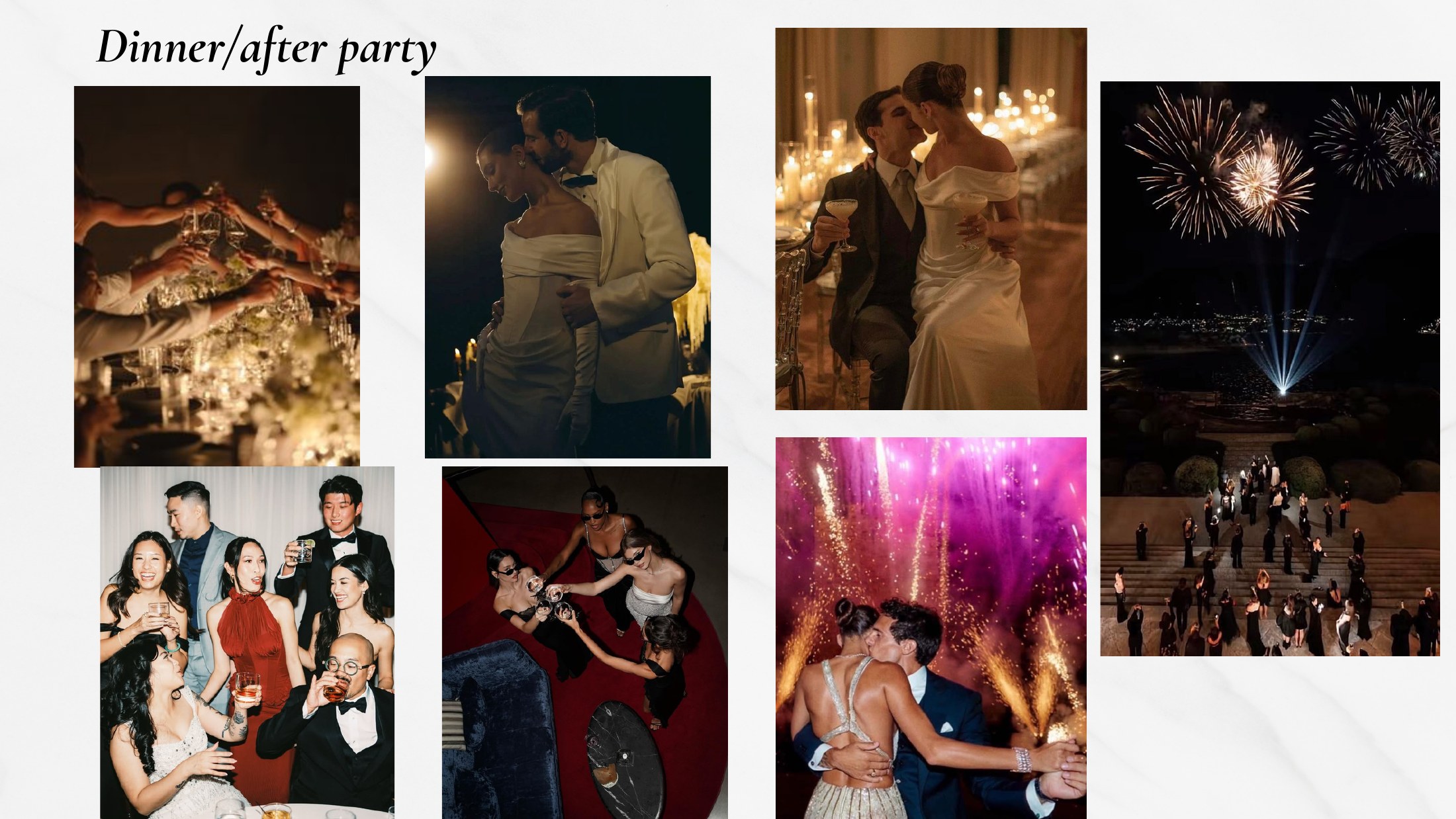
Dinner / After Party
Must Capture
- Toast reach-in over the candles — hands and glasses converging
- Couple slow-dancing between candlelit tables, warm and grainy
- Seated kiss at the table, coupe in hand
- Sunglasses-at-night group in the red lounge — direct flash, party energy
- Fireworks kiss; crowd on the steps under the beam light + fireworks wide
How to Shoot
- Dinner: available candlelight only, ISO up, embrace the grain
- After party: switch to direct on-camera flash — hard, fun, paparazzi
- Fireworks: one shooter tight on the couple, one wide on the crowd
Cinema Scenes — Film Language
Three narrative references. Not content, not reels — scenes from a film. Letterboxed, staged, patient.
Dinner table — slow lateral track
4s · dolly · 2.39 letterboxWhy: the camera glides along the dinner table like a film scene — red tulips and glassware sharp in the foreground, guests melting into warm bokeh behind. The dinner is a location in a movie, not coverage of a party.
- Slow lateral dolly/gimbal move down the table length — one direction, constant speed
- Focus lives on the tablescape; guests stay soft — florals act as passing focus wipes
- Expose for candle warmth, tungsten amber; nothing corrected to neutral
- Frame in 2.39 letterbox; keep the move going past the frame edge, cut mid-move
The gathering — reveal through the crowd
5s · handheld drift · blockingWhy: wood-panelled room, family in black-tie, and the bride in white glimpsed BETWEEN backs and shoulders as the camera drifts through. The reveal is blocked like drama — she appears and disappears as people move.
- Handheld drift THROUGH the group — camera moves behind observers, never around them
- Bride revealed in slivers between bodies; full reveal only at the end of the move
- Stage family interactions in depth layers: foreground backs, midground faces, bride beyond
- Warm sconce/window light, rich wood tones — grade towards amber and mahogany
- Use for the family moment before the ceremony — treat it as a scene with blocking, not a group shot
The bar booth — two of us, wide
4s · locked wide · sceneWhy: the couple alone in a booth of an old ornate bar — red lamp glowing, paintings crowding the wall, staff distant. A locked wide where they are small inside the set, having a real conversation. The escape-from-their-own-party beat.
- Locked-off wide; couple occupies a corner of the frame, the room does the talking
- Let it PLAY — 5s+ hold, real conversation, no direction beyond "sit together"
- Practicals only: table lamp, wall sconces; deep warm shadows
- Place late in the film — the two of them slipping away from the night
The Approach — Edit
Grade & Texture
Film emulation as the base: visible grain, halation blooming off every candle flame, warm amber mids, deep true blacks. No digital sharpness, no lifted matte blacks. Black & white is reserved for emotional peaks, not used at random.
Rhythm
Two speeds only: long held frames that breathe (3–5s), and strobe bursts of flash stills cut on the beat. Nothing in between — avoid standard 1–2s montage pacing. The contrast between stillness and burst IS the edit.
Blur = Emotion
Motion-blurred and ghosted frames are keepers, not rejects. Long-exposure streaks carry the feeling of the night — use them full-frame and as bridges between scenes instead of dissolves or wipes.
Type & Sound
Serif caption cards, letter-spaced, understated. Collage frames (diptych / triptych / grid) for social cuts. Six references carry attached 15s music cues — play them with sound and build the soundtrack in that lane, with vows, toasts and laughter running underneath.
Grade & Texture
The base look every scene passes through. Candlelight exposed as candlelight.
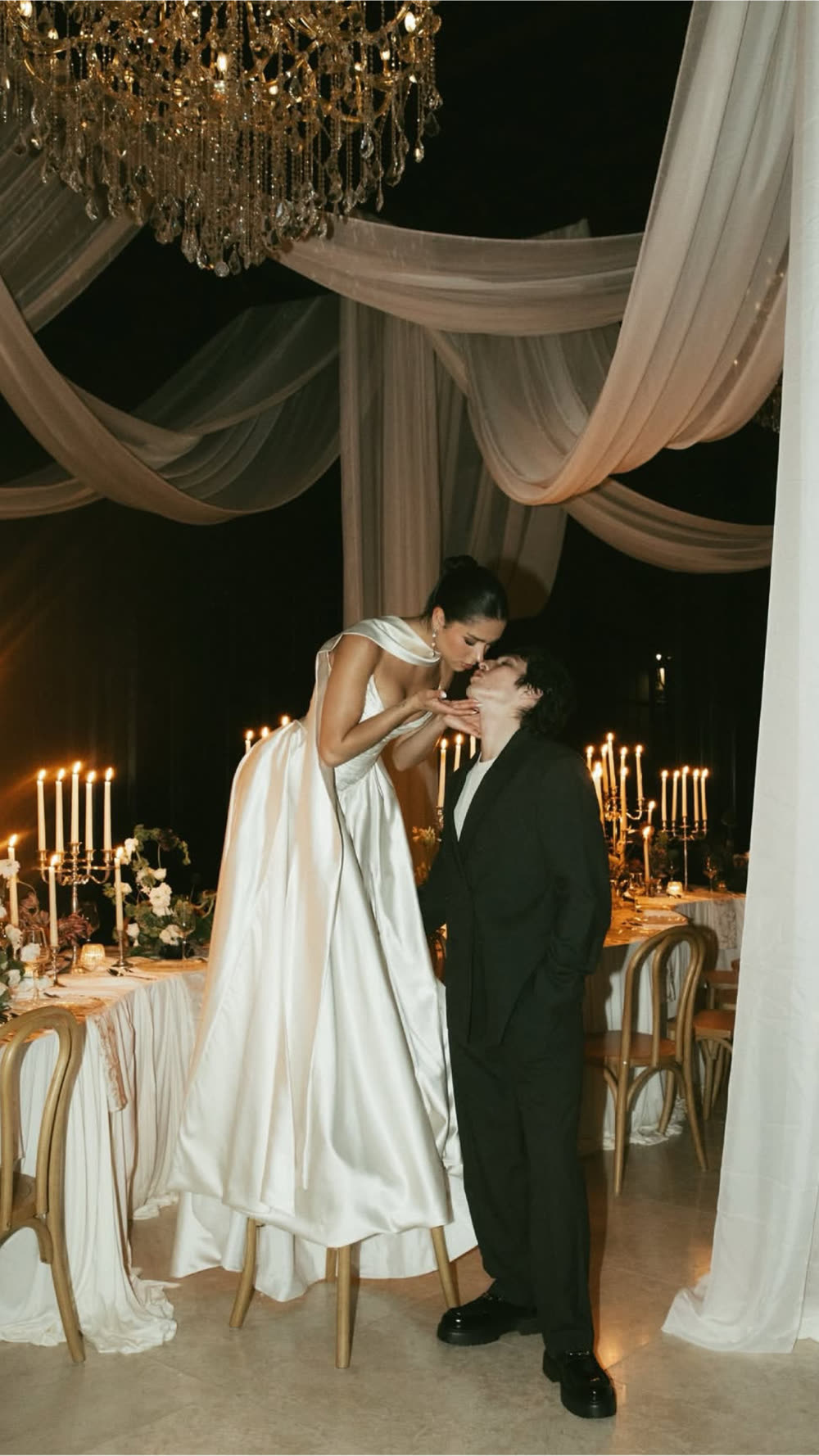
Base grade — chandelier kiss
still · colour referenceWhy: the master grade. Warm tungsten glow, deep blacks that stay black, ivory satin holding full detail.
- Match skin to this: warm, never orange
- Whites of the dress must not clip — protect highlights
- Shadows fall to true black, no grey matte lift
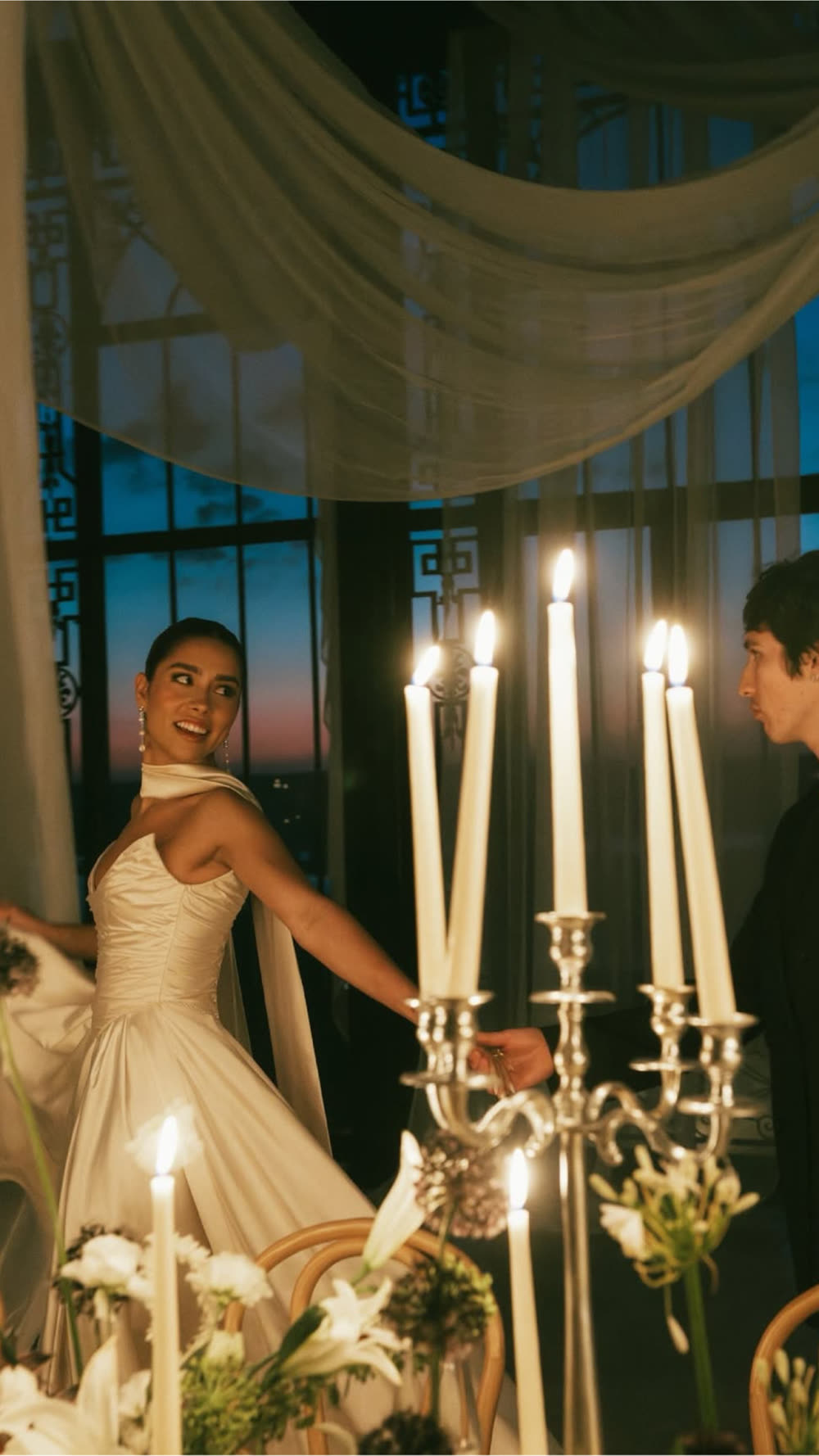
Mixed temps — blue hour vs candle
still · colour referenceWhy: dusk blue through the windows against amber candlelight inside — the two temperatures live in one frame.
- Do NOT neutralise the blue/amber split — it is the look
- Time-of-day storytelling: keep windows visible in wide shots
- White balance to the candles, let daylight go cool
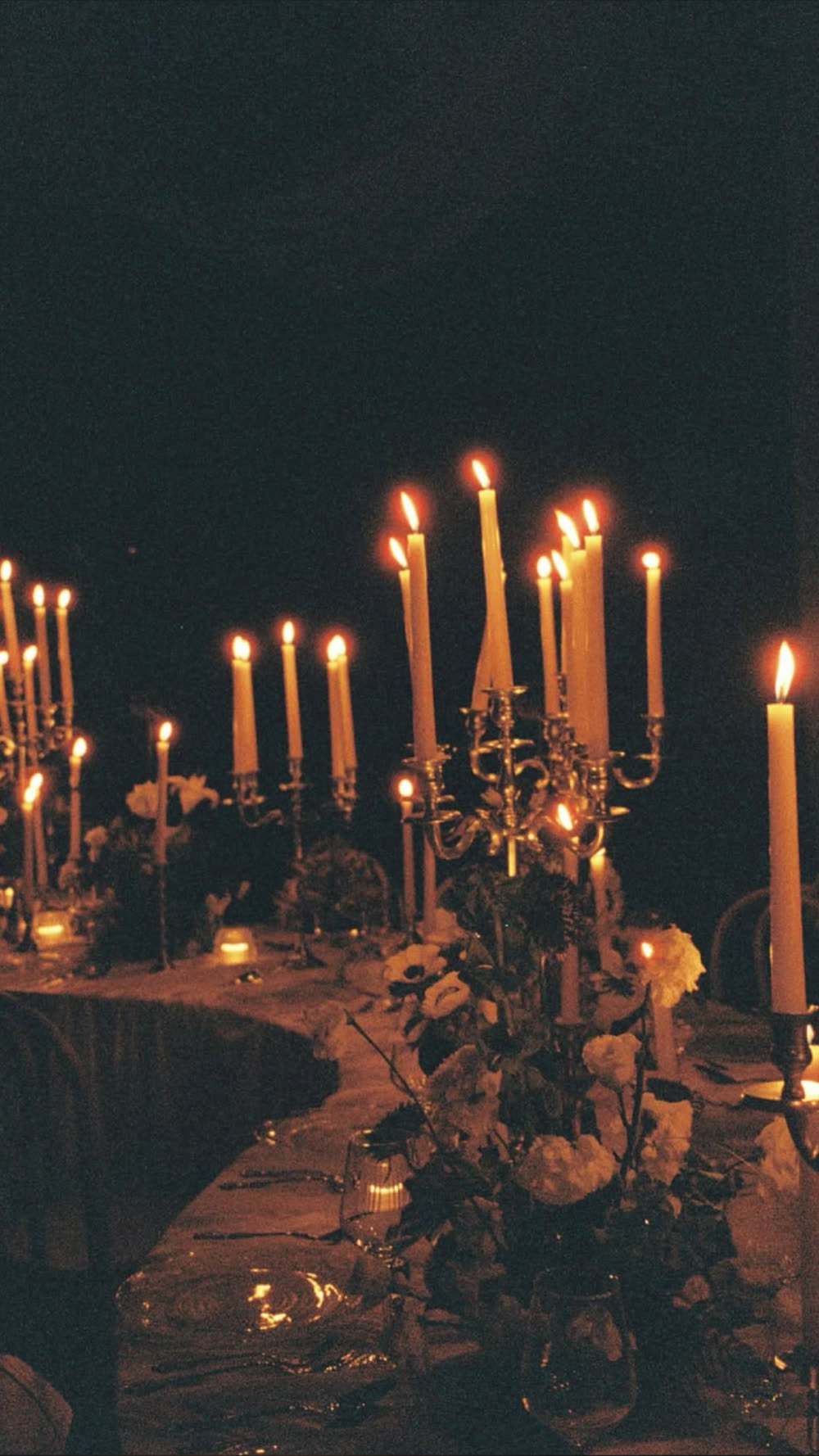
Candle field — expose for flame
still · texture referenceWhy: near-black frame, flames blooming with halation, grain everywhere. Darkness with texture, not murk.
- Underexpose rather than lift — noise/grain is welcome texture
- Add halation/glow on practicals in the grade if not in camera
- Use frames like this as chapter breathers
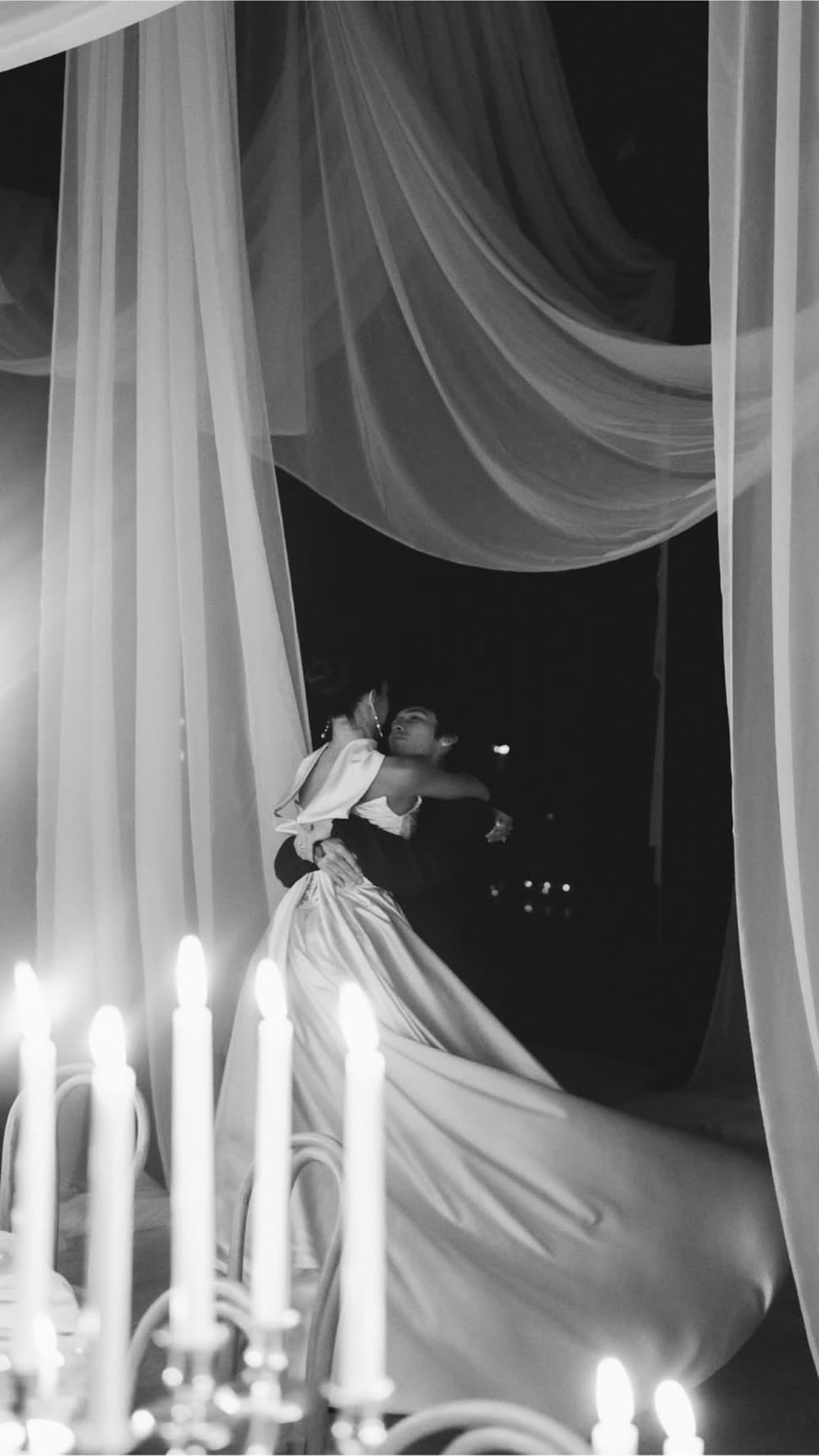
B&W — slow dance in the drapes
still · B&W referenceWhy: monochrome saved for the most emotional beat — soft contrast, glowing candles, drapery architecture.
- B&W conversions only on emotional peaks (first dance, tears, vows)
- Soft milky contrast — never crunchy high-contrast B&W
- Let highlights bloom; keep skin luminous
Motion Blur as Emotion
Blur is a feature. These frames replace dissolves, wipes and speed ramps.
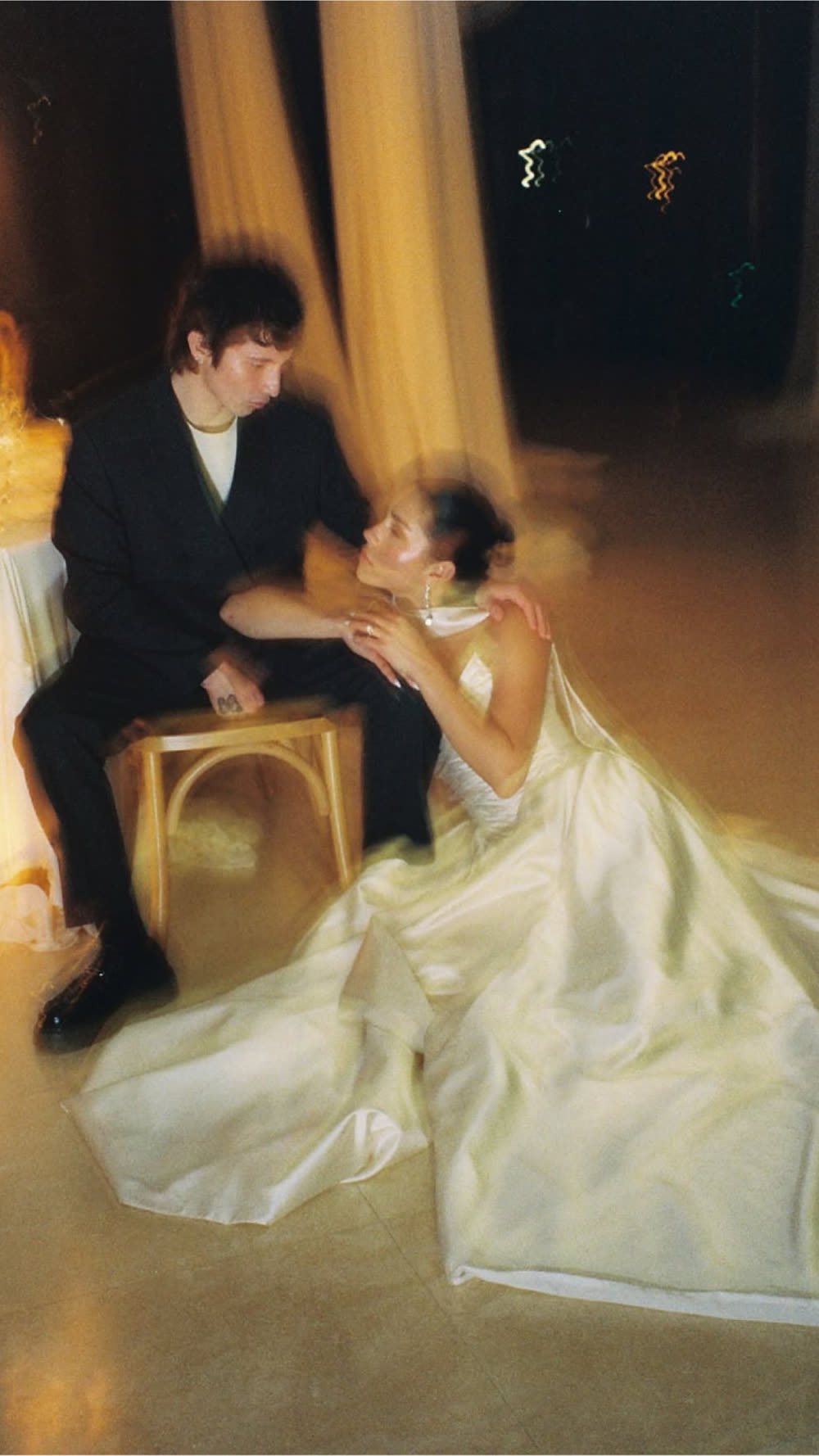
Ghost blur — the transition frame
still · techniqueWhy: long-exposure ghosting mid-movement — she reaches for him and half-disappears. This is how scenes should hand over to each other.
- Use blurred/ghosted frames full-screen as scene bridges
- No cross-dissolves — cut TO a blur, out of a blur
- In motion footage: emulate with dragged shutter or frame-blend on movement beats
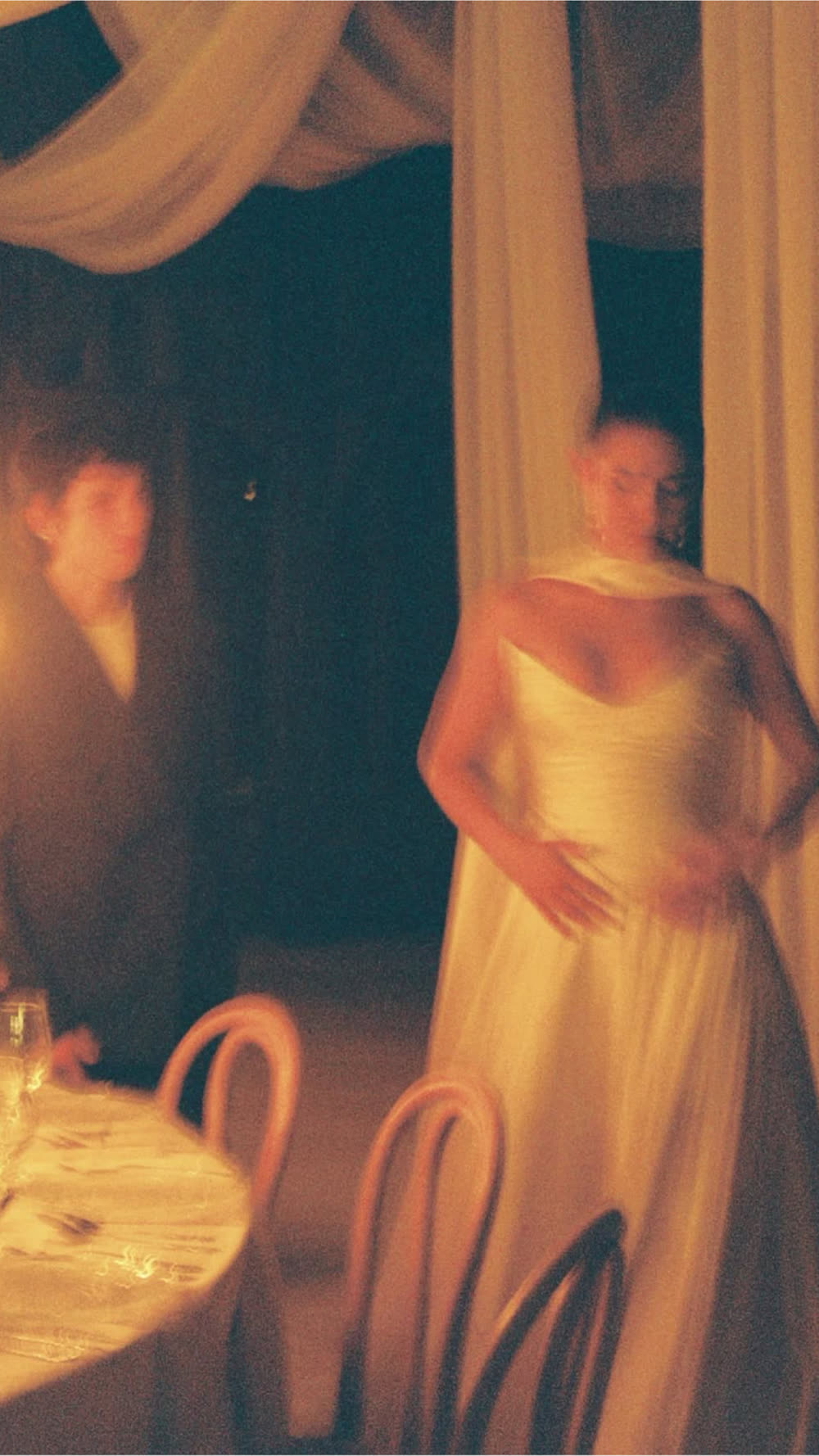
Both ghosts — dream register
still · techniqueWhy: both figures blurred mid-move, warm film wash — memory rather than record.
- Hold dream-register frames 2s+, letting music carry
- Grade warmer and softer than surrounding footage
- Best placed late in the film — the night melting
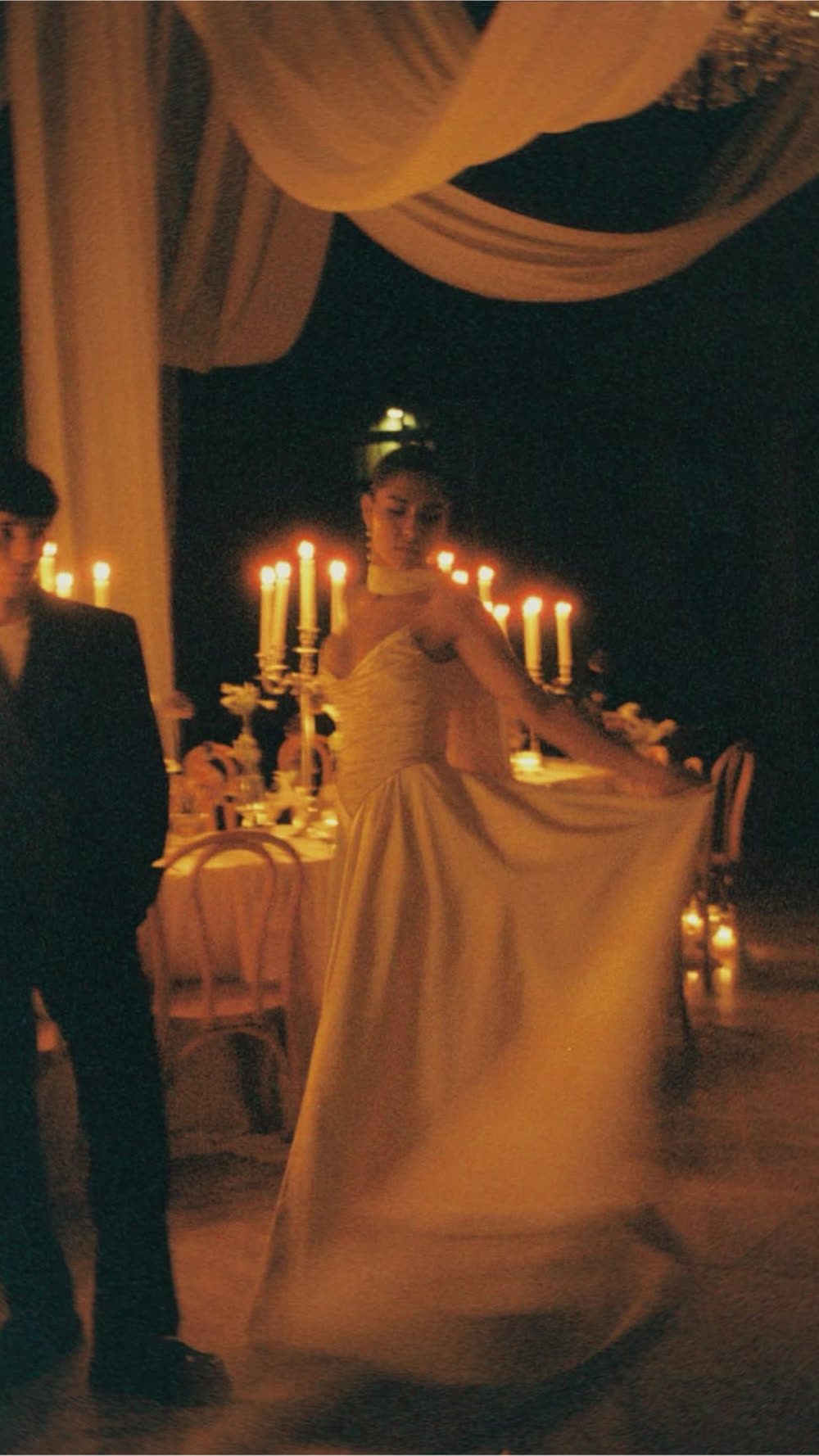
Heavy grain dance
still · texture + motionWhy: maximum grain, amber wash, dress mid-swirl — end-of-the-night energy where technical perfection stops mattering.
- Push grain hardest on party/dance sequences
- Blur + grain together — do not stabilise or denoise these
- Cut these on music swells, not on action
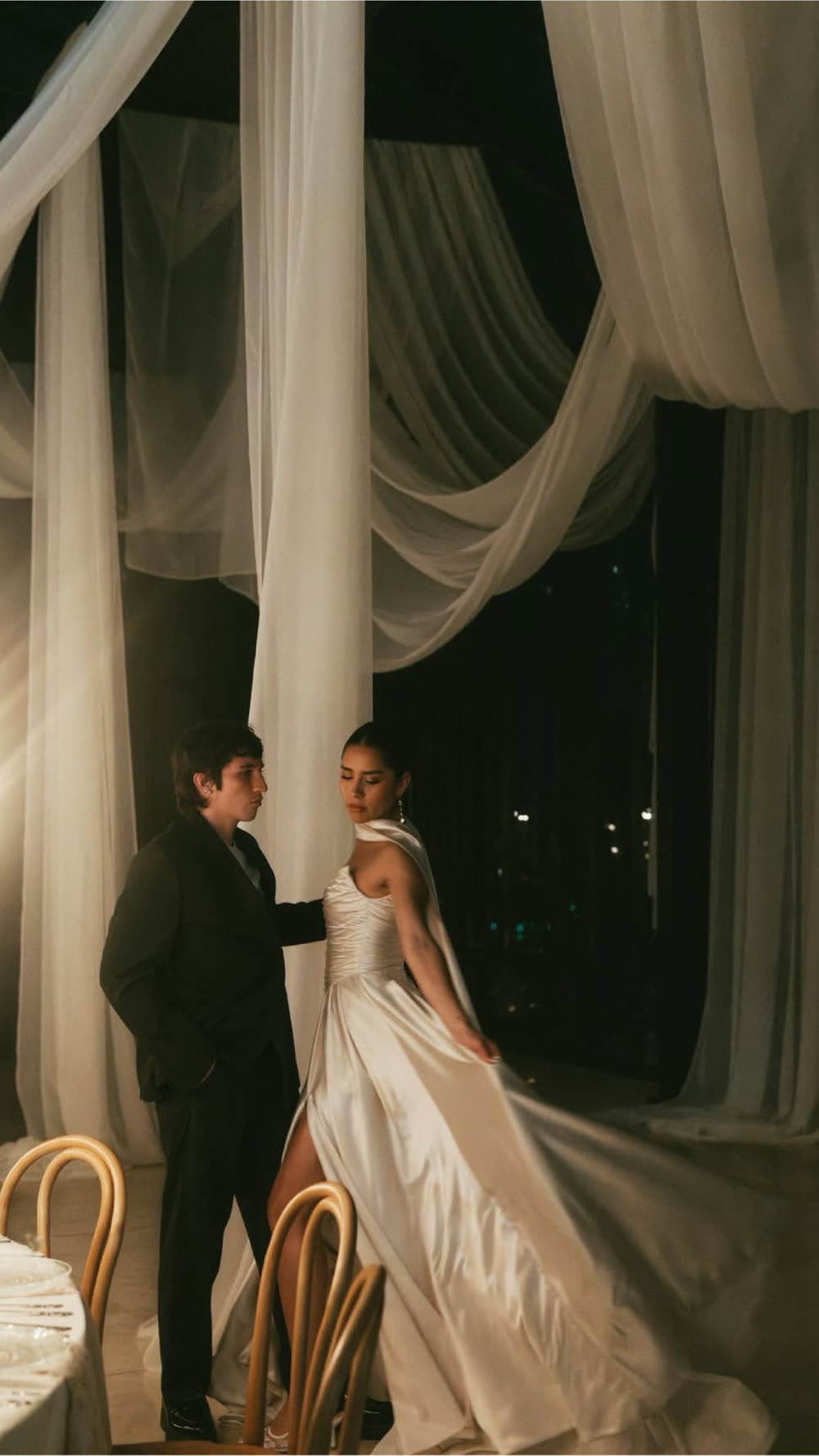
Haze & bloom
still · atmosphereWhy: the room breathing light — soft atmospheric bloom over the drapes and dress, edges melting.
- Gentle diffusion/Pro-Mist feel across wides
- Light wraps, nothing clinical or crisp
- Apply consistently — atmosphere is part of the grade, not an effect
Flash Frames & Burst Rhythm
The signature cutting technique — stills fired like a strobe, on the beat.
Martini burst — THE cutting reference
6s · motion · watch closelyWhy: one moment, many flash frames — rapid jump-crops punching in and out of the same image, cut like a strobe to the beat. This rhythm is the signature of the whole edit.
- Sequence near-identical flash stills at 2–4 frames per beat
- Punch-in / punch-out crops of the SAME image — zoom jumps, not moves
- Deploy in bursts of 1–3s max, then return to stillness
- Sync every cut to a drum hit — never free-floating
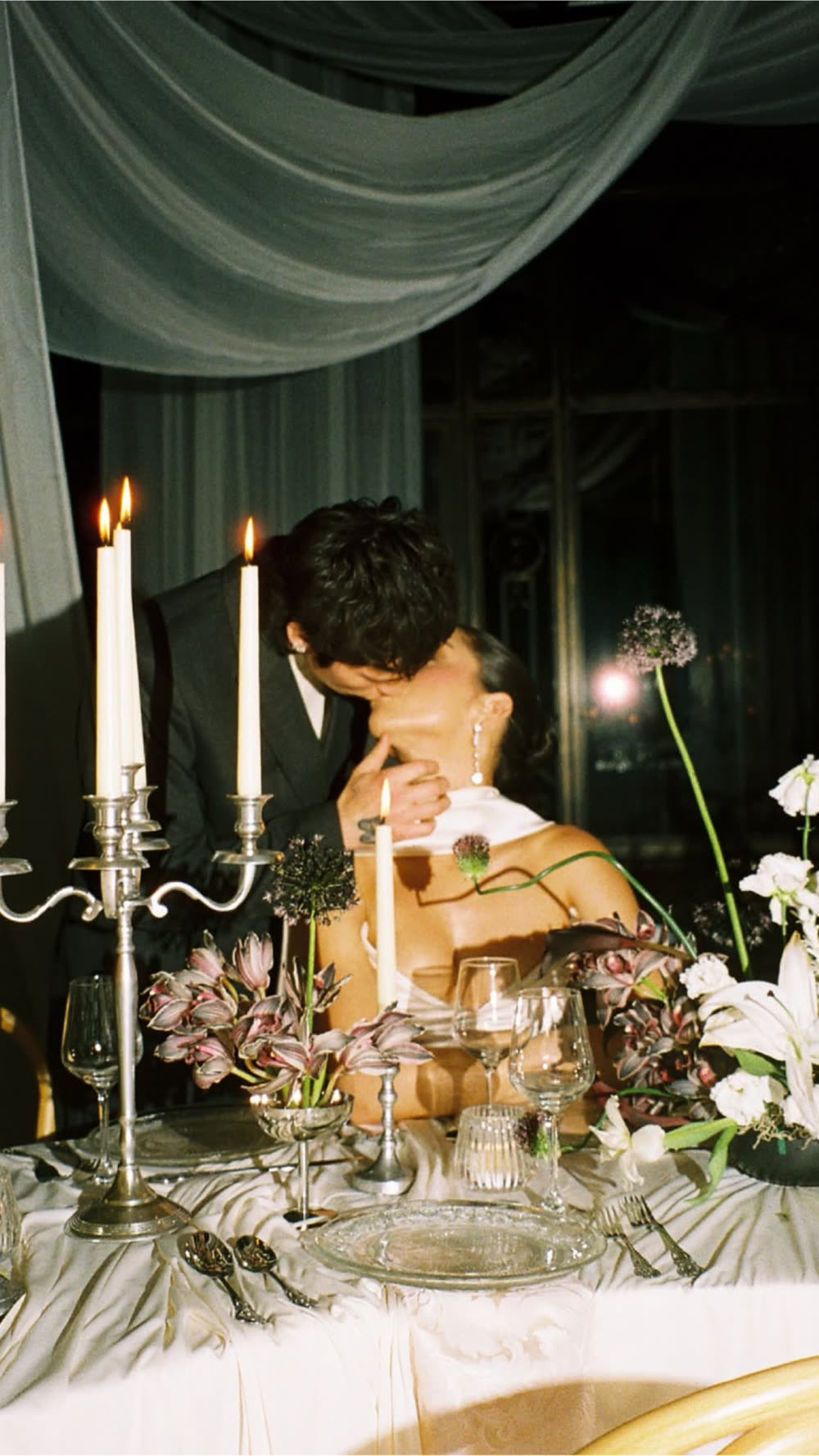
Direct flash — caught not staged
still · flash languageWhy: hard on-camera flash, film grain, imperfect spontaneous framing — paparazzi intimacy.
- Flash frames keep their raw crop — no reframing or straightening
- Grade flash stills brighter + cooler than the candlelit footage so they POP
- Use as single-frame punctuation between scenes
Flash kiss + music cue
15s · still + attached track · sound ONWhy: the flash-frame language paired with the exact music energy it should cut to — listen, don't just look.
- Pull tempo/energy from this track lane for the party act
- Flash stills land ON the vocal/drum hits of cues like this
Caught gesture — single-frame hit
15s · still + attached track · sound ONWhy: one flash frame of a mid-gesture moment — hand to lips, eyes elsewhere. A single beat-hit image with its track.
- Single flash frame = one musical accent; in and out
- Prioritise imperfect, in-between expressions over posed smiles
Collage & Typography
Layout language for social cuts, stills deliveries and in-film text.
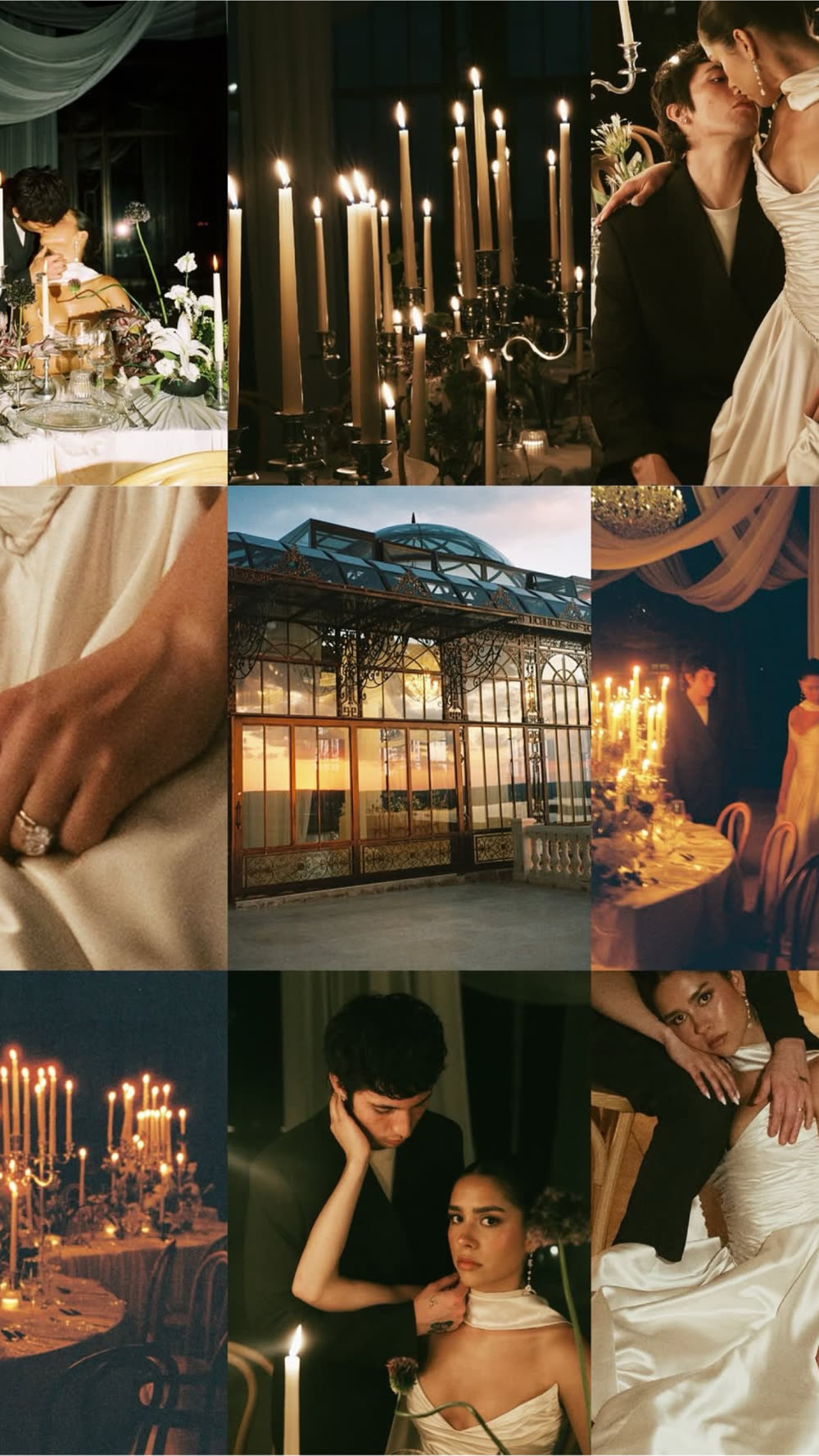
3×3 mood grid
still · layoutWhy: nine frames of the night in one grid — details, kisses, candles, portraits mixed.
- Build closing/recap frames as grids of stills from the day
- Mix scales: details beside faces beside wides
- Works as the final frame of social cuts
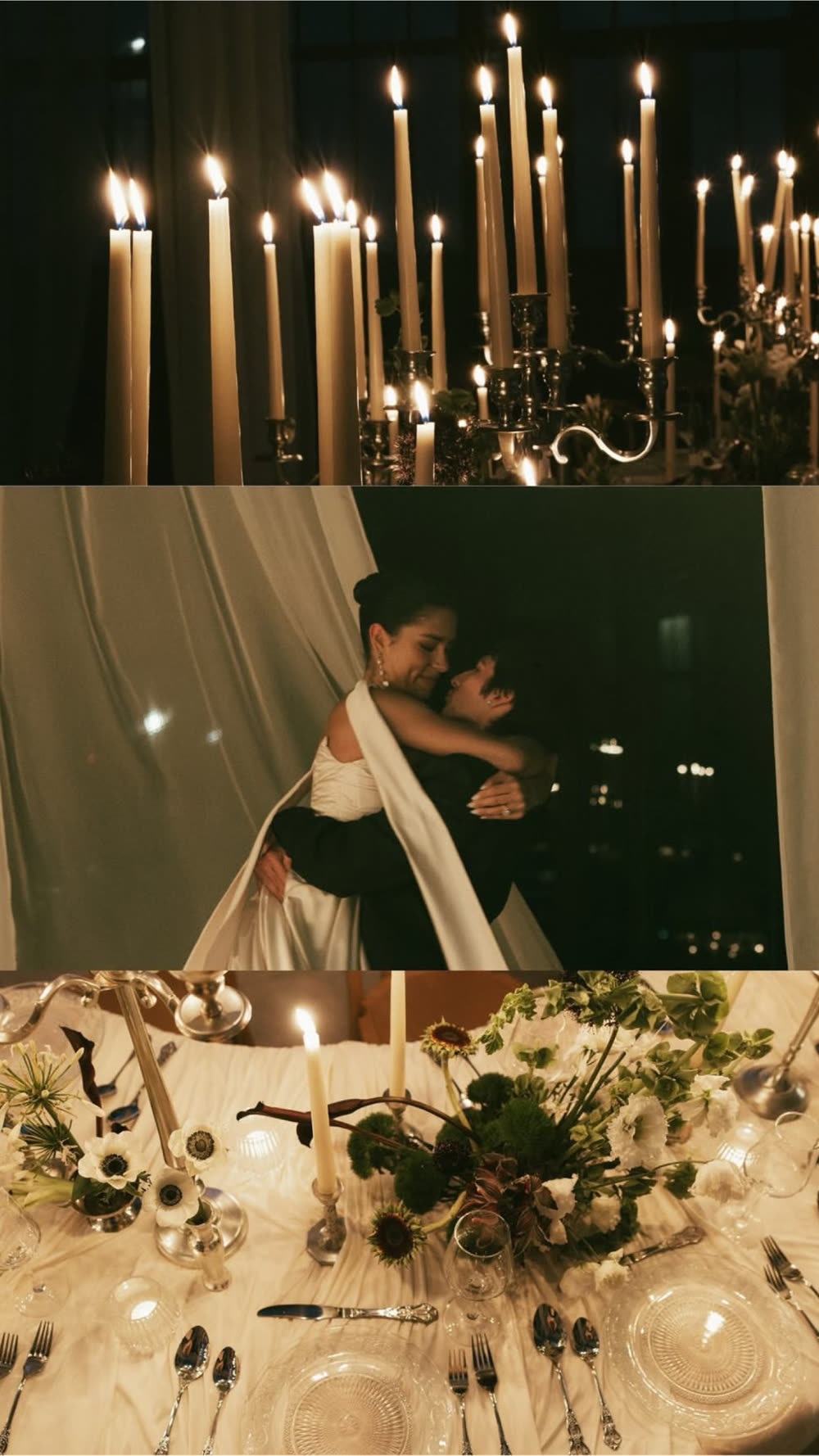
Vertical triptych stack
still · layoutWhy: candles / embrace / tablescape stacked — three registers of the same night in one vertical.
- Stack detail + emotion + place in vertical deliverables
- Keep gutters thin and white
Diptych repeat + track
15s · still + attached trackWhy: same couch scene, two near-identical frames stacked — repetition as a layout device, with its music cue.
- Repeat near-identical frames in layouts — variation IS the interest
- Editorial posing: her upright, him flat — keep the humour
Caption typography + track
15s · still + attached trackWhy: toast diptych with a letter-spaced serif caption below — the exact text treatment for cards and captions.
- Text cards: small serif caps, letter-spaced, centred, generous white space
- Words appear BETWEEN images, never overlaid on faces
- Tone of copy: quiet, intentional, third-person
Mixed grid — B&W meets colour
15s · still + attached trackWhy: group shots in B&W beside colour details and candids — the alternating texture of a full recap page.
- Alternate B&W groups with colour details in recap layouts
- Food, drinks, hands — details get equal billing with faces
Sound & Story Beats
Six references carry attached music — the soundtrack lane lives in them.
"This is Us" — opening beat
15s · still + attached track · sound ONWhy: the invitation suite among candles, scored — how the film should open: a detail, a title, a song establishing tone before any faces.
- Open on details + type, music first, people later
- Track lane: warm, soulful, cinematic — take tempo cues from all six attached tracks
- Real audio (vows, toasts, laughter) ducks under music, never disappears
- Editor: rip and Shazam the attached cues before choosing final tracks